SWIFT uses structured questions to identify how a system or activity could go wrong. The Structured What-If Checklist Technique combines a facilitated team discussion with prepared prompts and checklists. It helps engineers, operators and safety specialists examine credible failures, errors, consequences and safeguards.
The result should be a traceable set of concerns, decisions and actions. A productive workshop depends on preparation, relevant experience and follow-up. Completing a checklist does not establish that every hazard has been found.
Understand where SWIFT fits
SWIFT usually examines systems, subsystems or activities at a relatively high level. It can support an early hazard review, an operational assessment or the evaluation of a proposed change. It is useful when interfaces, working arrangements and human actions need attention.
IEC’s risk assessment summary describes SWIFT as a high-level risk identification technique. It can stand alone or form part of a staged approach with methods such as HAZOP or FMEA. [1]
HAZOP typically applies guidewords to defined design parameters or procedural steps. SWIFT allows broader questions about the system and its operation. Select the method and level of detail for the safety question. Complex sequences, severe consequences or uncertain protection performance can require more detailed analysis.
Prepare a clear scope and a capable team
Define the system boundary, intended operation and study objectives. Include normal, abnormal, maintenance and emergency conditions where relevant. State the interfaces and exclusions. If the study concerns a change, explain its purpose, duration and effects on equipment, procedures and training.
Provide current drawings, operating procedures, equipment limits and incident information. Include relevant requirements, earlier hazard studies and task analysis. Record information gaps so that the team can distinguish evidence from assumptions.
Appoint a competent facilitator and recorder. Include people with design, operational and maintenance knowledge, with specialist support where needed. A small team can work well, but expertise and participation matter more than a fixed headcount. Combining facilitation and recording can weaken the record when discussion becomes demanding.
Use questions and checklists in sequence
Organise the session around categories suited to the activity. Typical categories include external influences, human factors, maintenance, measurement errors, equipment failures, loss of integrity, utility failures, emergency operations and environmental effects.
Invite participants to generate questions before using the checklist to test coverage. This helps preserve independent thinking. Circulate the scope and reference information in advance. The facilitator can retain detailed prompts for use after the initial discussion, while allowing participants to contribute questions and evidence beforehand.
Questions can begin with What if, How could or Is it possible. For example: What if both teams believe that the other team has checked the valve positions? How could a power failure prevent isolation? What if the planned escape route is unavailable?
Record questions as they arise. Then examine each credible scenario. Identify causes, consequences, existing safeguards and unresolved issues. The facilitator should encourage challenge and prevent a confident participant from closing a question without a sound basis.
Record decisions that can be checked
Use a worksheet with separate columns for the question, consequences, existing safeguards and recommendations. Link related causes and scenarios where necessary. Record why the team considers safeguards sufficient, rather than leaving the decision implicit.
Give each action an owner, due date and completion criterion. State the safety objective that needs to be achieved. Record possible solutions without assuming that the first suggestion is the only acceptable design.
If the team uses a risk matrix, define the likelihood, consequence and exposure basis. A ranking can help prioritise actions. Adding ordinal scores does not provide a quantitative estimate of accident frequency or control reliability.
Worked example ship to ship fuel transfer
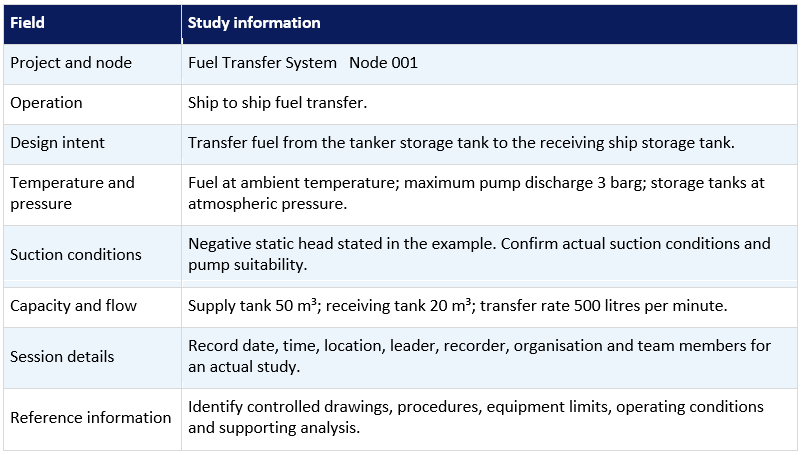
The retained tables describe transfer from a 50 m³ supply tank to a 20 m³ receiving tank. The example assumes ambient fuel, a transfer rate of 500 litres per minute and a maximum pump discharge pressure of 3 barg. These are teaching assumptions.
The worksheet asks about heavy weather, an incorrect tank connection, hose rupture, cold-weather pump failure and emergency manoeuvring. It demonstrates how SWIFT can connect environmental conditions, human actions and equipment behaviour in one review.
The source’s Force 4 weather limit, 50-metre separation and inspection intervals require validation for the actual vessels and transfer arrangement. They are not general operating instructions. Pump material suitability also depends on temperature, material grade, loading and design. Material identification alone cannot establish fitness for service.
Review shutdown, isolation and emergency disconnection together. Check spill consequences, response times and the risks introduced by disconnection. A proposed actuated valve or quick-release connection needs assessment and verification before it can be credited as a safeguard.
Case study Herald of Free Enterprise
The Herald of Free Enterprise capsized after leaving Zeebrugge on 6 March 1987 with its bow doors open. The formal investigation examined door-closing responsibilities, reporting arrangements and management failures. It also considered earlier requests for bridge indication of door status and recommended fail-safe indication arrangements. [2]
A SWIFT session on departure could ask: What if the person assigned to close the doors is unavailable? What if the bridge receives no report? How does the master confirm the actual door state? What if a reporting or indication system fails?
These are questions drawn from the investigation’s lessons. They are not evidence that a SWIFT study was performed or that the technique alone would have prevented the disaster. The case illustrates the need to examine assumptions about people, communications and physical system state.
Complete the review and verify the actions
At the end of each category, use the checklist to identify gaps. Before closing the session, ask whether any concern falls outside the selected categories. Review exclusions, assumptions and unanswered questions.
Issue the report, prioritise unresolved concerns and track actions to a justified resolution. Verify implementation evidence before closing actions. Link significant findings to the Hazard Log and relevant safety requirements. Review affected findings when equipment, operating conditions or responsibilities change. SWIFT adds value when its questions lead to effective controls and traceable decisions.
Hashtags
#SWIFT, #WhatIfAnalysis, #HazardIdentification, #SystemSafety, #RiskAssessment, #SafetyEngineering, #MarineSafety
Sources
[1] International Electrotechnical Commission TC 56. Risk assessment standards. Structured what if technique SWIFT summary. Read source
[2] Department of Transport. MV Herald of Free Enterprise. Report of Court No 8074 Formal Investigation. 1987. Sections on responsibilities, indicator lights and immediate action. Read source
Fuel transfer SWIFT study definition
Teaching example. The assumptions and safeguards below need validation against the actual vessels, equipment and operating arrangements.
Questions to extend the review
What if communications fail during transfer?
How could the receiving tank overfill despite the correct connection?
What if power loss prevents valve actuation?
How are simultaneous shutdown, hose isolation and emergency disconnection coordinated?
What if personnel cannot reach a local stop or manual valve safely?
These additional prompts extend the five scenarios in the worksheet. They do not establish that the review is complete.
Fuel transfer SWIFT worksheet
Node 001Ship to ship fuel transfer. Existing safeguards are those stated in the teaching example, not verified control performance.
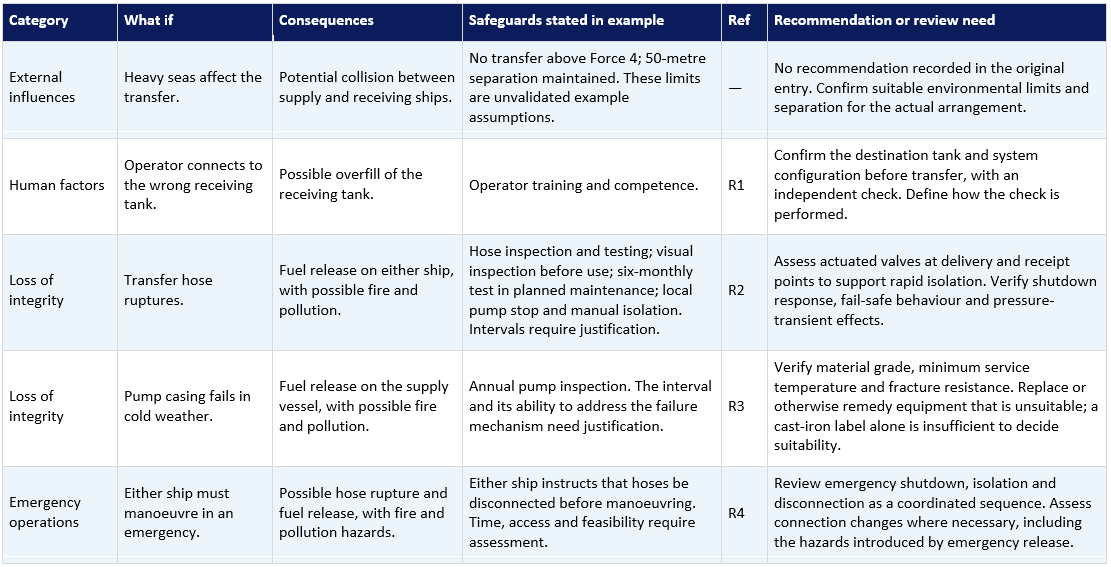
Recommendations are proposals for assessment. They cannot support a current risk claim until implemented and verified. Weather limits, separation, inspection intervals and material decisions must be justified for the actual system.