Designing Your Risk Assessment Program. Which Ingredients should we use? In this post, I draw upon my 25+ years in system safety to give you some BOLD advice! I’m going to dare to suggest which analysis tasks are essential to every System Safety Program. I also suggest which tasks are optional depending on the system that you are analyzing.
Which Ingredients should we use?
Everything – high novelty, challenging requirements, bespoke development and massive scrutiny);
The Bare Essentials;
New Designs and Integrations;
The Human Element;
Electronics, Software and Data;
Combining existing Systems; and
Environmental Protection.
Video Highlights
Topics
Designing Your Risk Assessment Program: Transcript
We’re onto Module Four – Designing Your Program.
This module aims to show you how to design a systematic, effective strategy for Risk Analysis. An effective program for Risk Analysis that isn’t wasteful. This module is a little bit longer than the others but bear with me! This is the real meat of what I promised you. So, let’s get started.
Multiple Points of View
As I said in a previous slide, we will deal with multiple points of view. We will use multiple points of view to look at the system from many different angles.
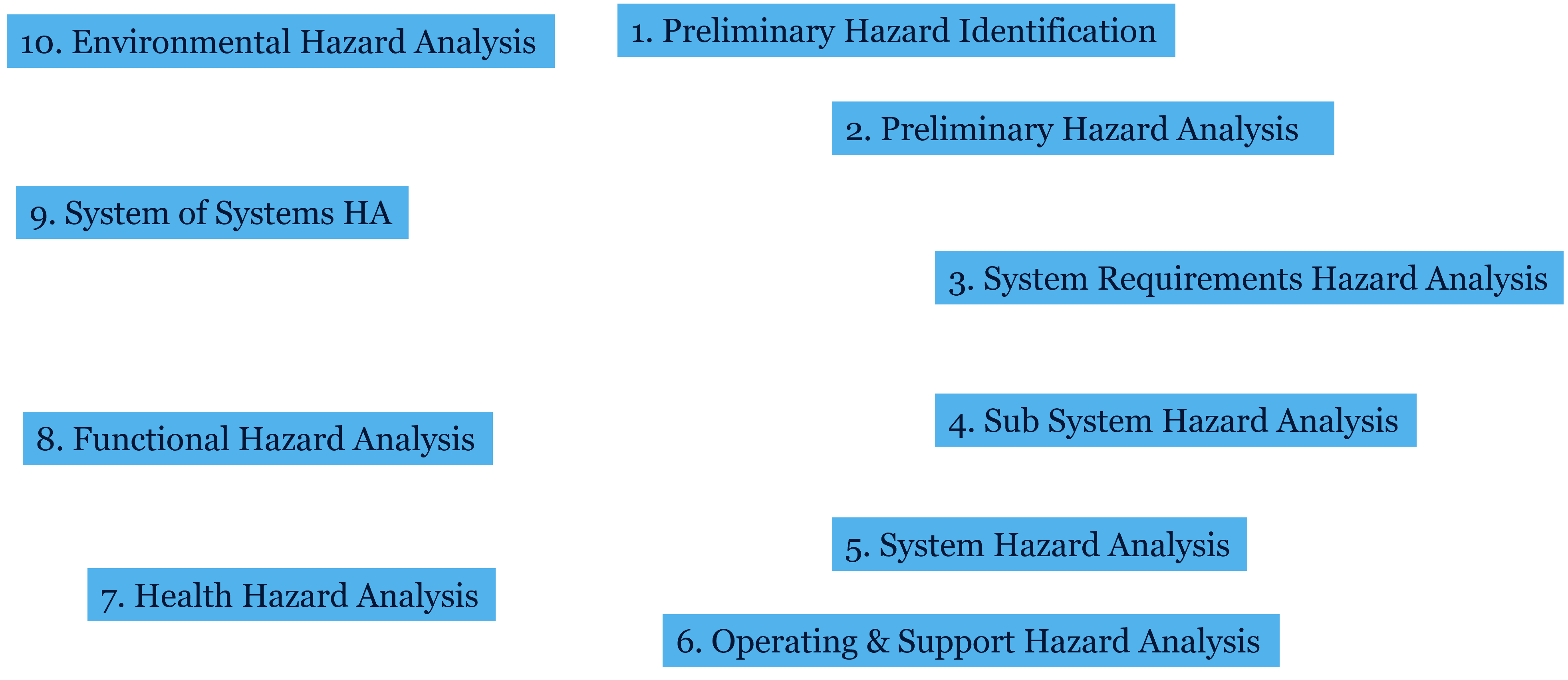
Ten different angles, in this case, one for each task. Each of those tasks brings a different perspective. So, each task has a different purpose. What they have in common is they are all there to bring out a different aspect of the system. They are different kinds of analysis, but they all have the same aim. To identify hazards and analyze hazards.
From that, we can then identify what we need to do to control those hazards. And that, in turn, gives us safety requirements. Sometimes they’re called ‘derived safety requirements’. They need to be met for the system to be safe. That’s the whole point of what we’re doing, as mentioned before.
Which Ingredients?
But if you’ve got everything then you only need all those 10 tasks if everything is in the red. Perhaps you’ve got a very novel system. You’ve got challenging performance requirements. You’ve got lots of bespoke development. And you’ve got a very critical system that’s going to get a lot of scrutiny. So, you need all 10 only if you’ve got a development from hell. Where you’ve got a very challenging development and you need all the tools you can get.
Now, that’s fine. That’s what the standard’s designed for. But very rarely are we going to work on a program where we’re pulling out all the stops. More often, we’re going to be working on something where there are some challenging areas and some less so. And we don’t need the entire program. We don’t need all 10 tasks to achieve success. And it’s OK to tailor your safety analysis to deliver value for money. In fact, this approach is better.
So, we’ve got some options here. I’m going to take you through the bare essentials. Those are what you need to do for every safety program. The work that we would do to address new designs and new integrations. Work that we would do to address the human element. This includes both parts of human factors. That’s the human contribution to safety and the impact that the system might have on human health. So, there’s a bit of back and forth in there in the two tasks there.
Then if our system has got programmable electronic software, we might need to look at that. Or if it has data that is being developed or modified, we need to look at that too. We need to assess the safety implications of the modifications/development. We might consider combining existing systems into a system of systems. And then finally, we might have to do environmental protection. So, the bare essentials plus those five optional elements are the ones that we will look at.
The Essentials #1
Let’s start with the essentials. I’m going to say it’s axiomatic – that every program needs these three tasks. It needs Preliminary Hazard Identification. It needs Preliminary Hazard Analysis. And it needs System Requirements Hazard Analysis. The last one is about identifying safety requirements for the system.
Now, that’s a very bold statement, is it for me to say you must have these elements in every safety program? Let me justify that, first of all, before I explain it a little bit in the next slide.
The first thing to note is that you can do these tasks early on. They are quick and cheap tasks if you do them early enough. If you do them early enough, it’s low granularity. So, it can be a quick and simple analysis. And because of that, it’s cheap. But don’t let that fool you! Getting in early and thinking about Risk early gives us valuable insight. Insight that we can then take action on. So we get actionable results early enough in the program to do something about it if we do it.
The second point to note with these three is that every other task depends on their outputs. Indeed, if you’re going to successfully tailor a safety program, you need the output from these tasks. They will help you focus on what’s important and what’s less important.
Thirdly, from experience, almost every program suffers from not doing these three tasks. Whether that be well enough, early enough, or both. I’ve never been on a program where we said, ‘We did too much Preliminary Hazard Identification Analysis!’. Nor ‘We did too much identification of safety requirements!’. That has never, ever happened in more than 20 years of experience working on safety programs.
It’s always been the opposite. We wish we’d done more. We wish we’d gone in earlier with these tasks. Then we would have known something that would have helped us to make sensible decisions. Ultimately, it would have saved a lot of time and money too! Think of these essentials as an investment, because that’s what they are…
This is Module 4 of SSRAP
This is Module 4 of the System Safety Risk Assessment Program (SSRAP) Course. Risk Analysis Programs – Design a System Safety Program for any system in any application.
The full course comprises 15 lessons and 1.5 hours of video content, plus resources. It’s on pre-sale at HALF PRICE until September 1st, 2024. Check out all the free preview videos here and order using the coupon “Pre-order-Half-Price-SSRAP”. But don’t leave it too long because there are only 100 half-price courses available!
Meet the Author

Learn safety engineering with me, an industry professional with 25 years of experience, I have:
•Worked on aircraft, ships, submarines, ATMS, trains, and software;
•Tiny programs to some of the biggest (Eurofighter, Future Submarine);
•In the UK and Australia, on US and European programs;
•Taught safety to hundreds of people in the classroom, and thousands online;
•Presented on safety topics at several international conferences.