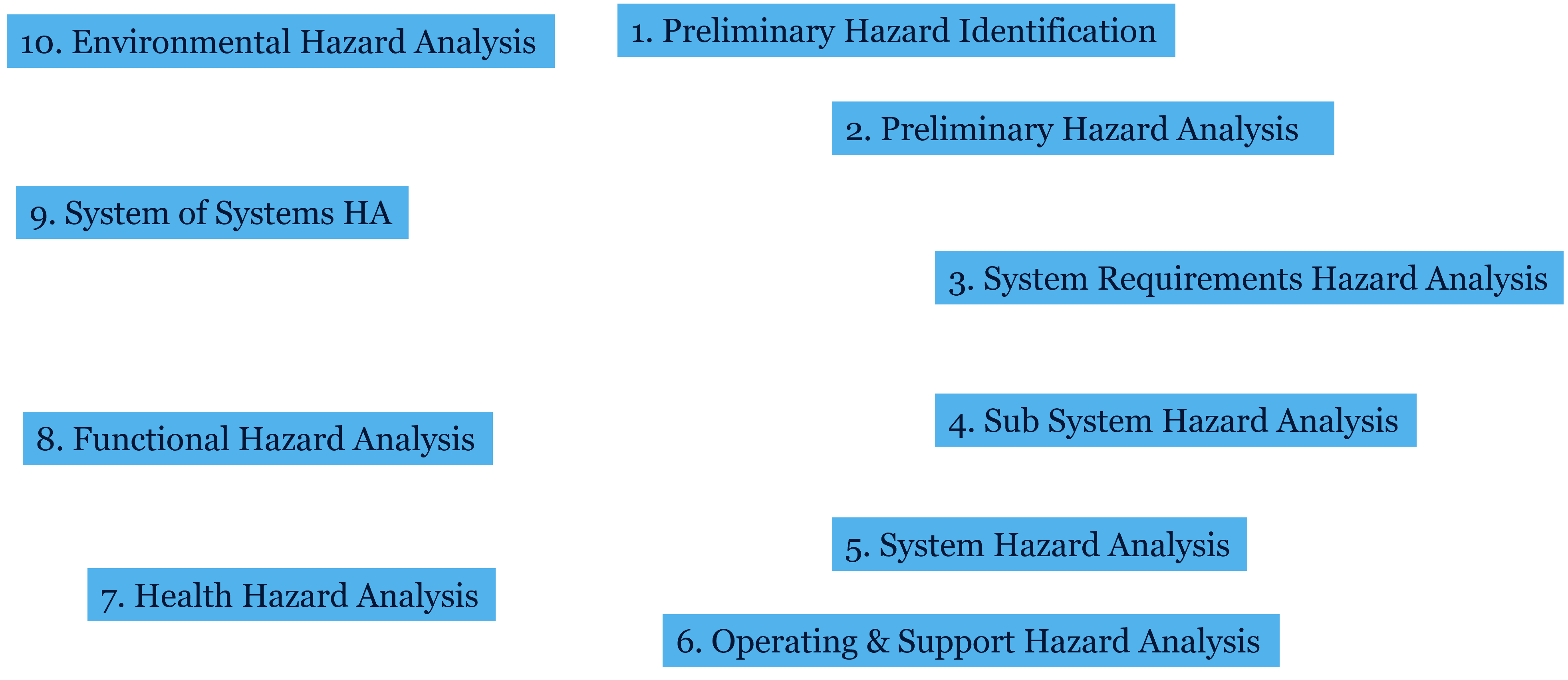
This is the full-length (one hour) session on Environmental Hazard Analysis (EHA), which is Task 210 in Mil-Std-882E. I explore the aim, task description, and contracting requirements of this Task, but this is only half the video. In the commentary, I then look at environmental requirements in the USA, UK, and Australia, before examining how to apply EHA in detail under the Australian/international regime. This uses my practical experience of applying EHA.
You Will Learn to:
Conduct EHA according to the standard;
Record EHA results correctly;
Contract for EHA successfully;
Be aware of the regulatory scene in the US, UK, and Australia;
Appreciate the complexities of conducting EHA in Australia; and
Recognize when your EHA program requires specialist support.
Topics: Environmental Hazard Analysis
Environmental Hazard Analysis (EHA) Purpose;
Task Description (7+ slides);
Documentation, HAZMAT & Contracting (2 slides each);
Commentary (8 slides); and
Conclusion.
Transcript: Environmental Hazard Analysis
Introduction
Hi, everyone, and welcome to the Safety Artisan. Today, we’re going to be talking about Environmental Hazard Analysis – A big topic! And I’m covering this as part of the series on the System Safety Engineering Standard – Mil. Standard 882E. But it doesn’t really matter what standard we are using the topic is still relevant.
Environmental Hazard Analysis is a big topic because we’ll cover everything, not just hazards. At the end of this session, you should be able to enjoy three benefits. First of all, you should know how to approach Environmental hazard analysis from:
The point of view of the requirements,
The Hazard Analysis itself (the process), and
Some national and international variations in the English-speaking world.
So, you should know how to do the basics and also to recognize when maybe you need to bring in a specialist.
But maybe most important of all, number three is you should have the confidence to be able to get started. So I’m hoping that this session is really going to help you get started, know what you can do, and then maybe recognize when you need to bring in some specialist help or go and seek some further information.
As you’ll see, it’s a big, complex subject. I can get you started today, but that’s all I can do in one session. And in fact, I think that’s all anyone can do in one session. Anyway, let’s get on with it and see what we’ve got.
Environmental Hazard Analysis, Mil-Std-882E Task 210
Environmental Hazard Analysis, which is Task 210 under Mil. Standard 882E. So let’s look at what we’re going to talk about today.
Topics for this Session
And you’ll see why it’s going to be quite a lengthy session. I think it will last an hour because we’re going to go through the Purpose and Task Description of Environmental Hazard Analysis as set out in the Mil. Standard. And it says seven-plus slides because there are seven mainstream slides plus some illustrations in there as well. Then we’ve got a couple of slides each on Documentation, Hazardous Materials or HAZMAT, and Contracting. Then eight slides of Commentary and this is the major value add because I’ll be talking about applying Environmental Hazard Analysis in a US, UK, and Australian jurisdiction under the different laws, which I have some experience of.
I worked closely with environmental specialists on the Eurofighter Typhoon project, and I’ve also worked closely with the same specialists on US programs which had been bought by different countries. And then finally, I’ve been closely involved in a major environmental – or safety and environmental – project here in Australia. So I’ve been exposed and learned the hard way about how things work or don’t work here in Australia. So I’ve got some relevant experience to share with you, as well as some learned material to share with you. And then a little Conclusion, because I say this will take us an hour so there’s quite a lot of material to cover. So, let’s get right on with it.
EHA
So the purpose of Environmental Hazards Analysis, or EHA, as it says, is to support design development decisions. Now all of the 882 tasks are meant to do this, but actually, the wording in Task 210 is the clearest of all of them. Really makes it explicit what we’re trying to do, which is excellent.
So we’re going to identify hazards throughout the life cycle – cradle to grave, whatever system it is. We’re going to document and record those hazards and their leading particulars within the Hazard Tracking System or Hazard Log, as we more often call it. We’re going to manage the hazards using the same system safety process in Section Four as we use for safety. This is the process that you will have heard in the other lessons that I’ve given. And very often under 882, Safety and Environmental Hazards are considered together. There are pros and cons with that approach, but nevertheless, a lot of the work is common. We’ll see why later on.
In this American standard, it says we are to provide specific data to support the National Environmental Policy Act and executive order requirements. So the NEPA is an American piece of legislation and therefore I use this color blue to indicate anything that’s an American-specific requirement. So if you’re not operating in America, you’ll need to find the equivalent to manage to and to comply with. Moving on…
…see the full transcript here (TBD).
Links: Environmental Hazard Analysis
The links mentioned in the video are here:
US Environmental Policy Agency,1970: https://www.epa.gov/
US Gateway to state resource locators: https://www.envcap.org/srl/index.php
Various laws and regulations, many from implementing European Directives: https://ec.europa.eu/environment/index_en
Scottish Environmental Protection Agency (SEPA) https://www.sepa.org.uk/ and
For free video lessons & free previews of paid content, subscribe to The Safety Artisan: https://www.youtube.com/channel/UCwH0-q4H-sjmGEqydS70xfA
You can find a free pdf of the System Safety Engineering Standard, Mil-Std-882E, here.
Meet the Author

Learn safety engineering with me, an industry professional with 25 years of experience, I have:
•Worked on aircraft, ships, submarines, ATMS, trains, and software;
•Tiny programs to some of the biggest (Eurofighter, Future Submarine);
•In the UK and Australia, on US and European programs;
•Taught safety to hundreds of people in the classroom, and thousands online;
•Presented on safety topics at several international conferences.