blog

Preliminary Hazard Identification & Analysis Guide: Free

Get the Preliminary Hazard Identification & Analysis Guide for free! It’s a 50-page .pdf download, collated from reliable sources. Contents: Preliminary Hazard Identification & Analysis Guide – Introduction Hazard Identification has been defined as: “The process of identifying and listing the hazards and accidents associated with a system.” Hazard Analysis has been defined as: “The […]

Get the Preliminary Hazard Identification & Analysis Guide for free! It’s a 50-page .pdf download, collated from reliable sources.

Contents:

  • Introduction …………………………….1

  • Aim …………………………………………1

  • Description ………………………………2

  • Method ……………………………………3

  • Guidance …………………………………4

  • Inspect the Workplace ………………7

  • How to find hazards …………………8

  • Review available information ……8

  • Consult Your Workers ……………..10

  • When to Consult with Workers …10

  • Hazard Checklists ……………………12

  • Functional Safety Analysis ……….16

  • FMEA/FMECA ……………………….21

  • SWIFT …………………………………..28

  • HAZOP ………………………………….42

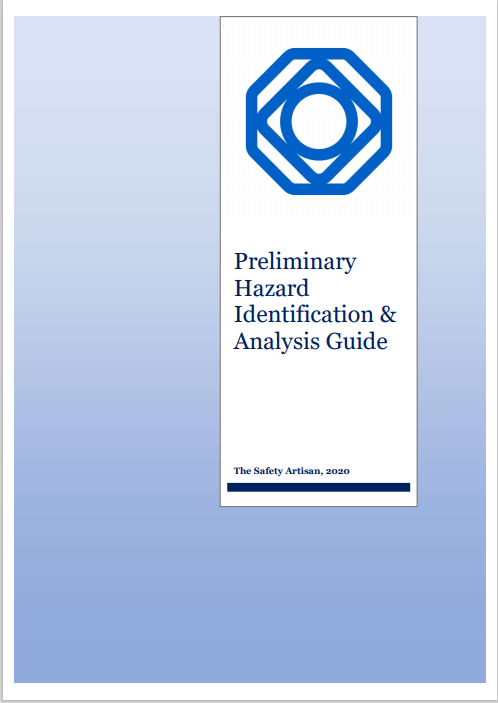
Front cover of PHIA Guide
The Safety Artisan’s PHIA Guide

Preliminary Hazard Identification & Analysis Guide – Introduction

Hazard Identification has been defined as: “The process of identifying and listing the hazards and accidents associated with a system.”

Hazard Analysis has been defined as: “The process of describing in detail the hazards and accidents associated with a system and defining accident sequences.”

Preliminary Hazard Identification and Analysis (PHIA) is intended to help you determine the scope of the safety activities and requirements. It identifies the main hazards likely to arise from the capability and functionality being provided. It is carried out as early as possible in the project life cycle, providing an important early input to setting Safety requirements and refining the Project Safety Plan.

PHIA seeks to answer, at an early stage of the project, the question: “What Hazards and Accidents might affect this system and how could they happen?”

Aim

The aim of the PHIA is to identify, as early as possible, the main Hazards and Accidents that may arise during the life of the system. It provides input to:

  1. Scoping the subsequent Safety activities required in any Safety Plan. A successful PHIA will help to gauge the proportionate effort that is likely to be required to produce an effective Safety Case, proportionate to risks.

  2. Selecting or eliminating options for subsequent assessment.

  3. Setting the initial Safety requirements and criteria.

  4. Subsequent Hazard Analyses.

  5. Initiate Hazard Log.

Did You Know?

You can also get the Guide with the PHIA Courses on Udemy.

Preliminary Hazard Identification & Analysis Guide: Free

Simon Di Nucci
Simon Di Nucci

Simon Di Nucci, CPEng, FIEAust, NER, brings 30 years of experience in safety engineering and consultancy. His work spans aircraft, ships, submarines, air-traffic management systems, trains and software in the UK and Australia.

About the author

Keep exploring.

All resources
blog

Risk Assessment Standards: How to Choose and Use Them

Risk Assessment Standards: How to Choose and Use Them. The standard is the thing that we’re going to use to achieve things – the tool. And that’s important because tools designed to do certain things usually perform well. But they don’t always perform well on other things. So we will ask, ‘Are we doing the […]

Read article
blog

Risk Management: Principles, Process and Techniques

Welcome to Risk Management: Principles, Process and Techniques, where we’re going to go through these basic concepts of risk management. We’re going to break it down into the constituent parts and then we’re going to build it up again and show you how it’s done. I’ve been involved in risk management, in project risk management, […]

Read article
behind the scenes

Artificial Intelligence: How Do We Use It Ethically?

Let’s talk about Artificial Intelligence: How Do We Use It Ethically? There’s been a lot of interest in this topic recently, as well as quite a lot of emotion and misinformation. I wanted to set out how the Safety Artisan uses Artificial Intelligence, or AI, ethically. But to do that, we have to understand what […]

Read article

THE SAFETY ARTISAN NEWSLETTER

Keep learning.
Stay curious.

Practical safety ideas and training updates from Simon, delivered to your inbox.

You can unsubscribe at any time. If the form does not load, open it directly.