Are you looking for Safety Engineering Jobs in Australia? Thinking of moving into the profession and wondering if it’s worth it? Already a safety engineer and thinking of moving to Australia (Poms, take note)? Then this article is for you!
Introduction
The most popular online job site in Australia is seek.com.au. If we go on this website and search for jobs, let’s say, up to $200,000 salary, we will see about a quarter of a million jobs listed.
I can tell you from personal experience that the market for skilled jobs is very buoyant at the moment. Recruiting is very difficult and this is driving up salaries.
Now, out of those quarter of a million jobs, if we search on the terms safe or safety, we will get somewhere between 45,000 and 60,000 hits. Of course, this does not mean that there are that many safety jobs. Lots of job ads include the word ‘safe’ or ‘safety’ as a motherhood and apple pie statement. “We are committed to having a safe working environment”, or something like that.
Specific Types of Safety Jobs
The seek search engine helps us. If we just type in the word ‘safe’ it comes up with five suggestions, and these are safety advisor, safety engineer, safety officer, safety coordinator, and safety manager.
Safety Advisor – 2,000 jobs;
Safety Officer – 2,000 jobs;
Safety Coordinator – 880 jobs;
Safety Manager – 2,200 jobs; and
Safety Engineer – 700 jobs.
Let’s quickly deal with the terminology here. Safety officer, safety coordinator, and safety advisor are jobs that tend to be in the work health and safety or WHS area. This is what we used to call occupational health and safety in Australia.
If you want a job in these areas you will often find that you need industry-specific experience, because you are dealing with quite hands-on issues of occupational health and safety. Wages are okay in these sectors, although not spectacular.
If you want to work in Safety and earn more money, you probably need to look at becoming a safety manager or safety engineer.
There are quite a lot of safety manager jobs available. And they are in all sorts of industries. You’re going to need quite a lot of safety experience in order to get one of these jobs, be it in WHS or safety engineering. You will also need to be able to manage other people, rather than doing hands-on engineering work yourself.
We will look at safety management another time.
Let’s Look at Safety Engineer Jobs
Out of 700 safety engineer jobs, this is where they are. No surprise that engineering is top of the list, but only 44% of safety engineer jobs are in engineering.
Engineering | 310 |
Construction | 86 |
Mining, Resources & Energy | 76 |
Government & Defence | 58 |
Manufacturing, Transport & Logistics | 48 |
Trades & Services | 41 |
Information & Communication Technology | 17 |
Human Resources & Recruitment | 16 |
Sales | 13 |
Administration & Office Support | 10 |
Hospitality & Tourism | 7 |
Accounting | 5 |
Call Centre & Customer Service | 3 |
Science & Technology | 3 |
Education & Training | 2 |
CEO & General Management | 1 |
Consulting & Strategy | 1 |
Marketing & Communications | 1 |
Real Estate & Property | 1 |
Retail & Consumer Products | 1 |
Table – breakdown of Safety Engineer Jobs by Employment Sector
We can see the breakdown better in this table. Construction, Mining, Resources & Energy, Government & Defence, Manufacturing, Transport & Logistics, and Trades & Services account for another 44% of positions. Many of these categories should come as no surprise. Mining and Resources are Australia’s biggest export earners (followed by education, interestingly). Ours is a vast country with plenty of room to expand, so construction, Transport & Logistics are always going to be big employers.
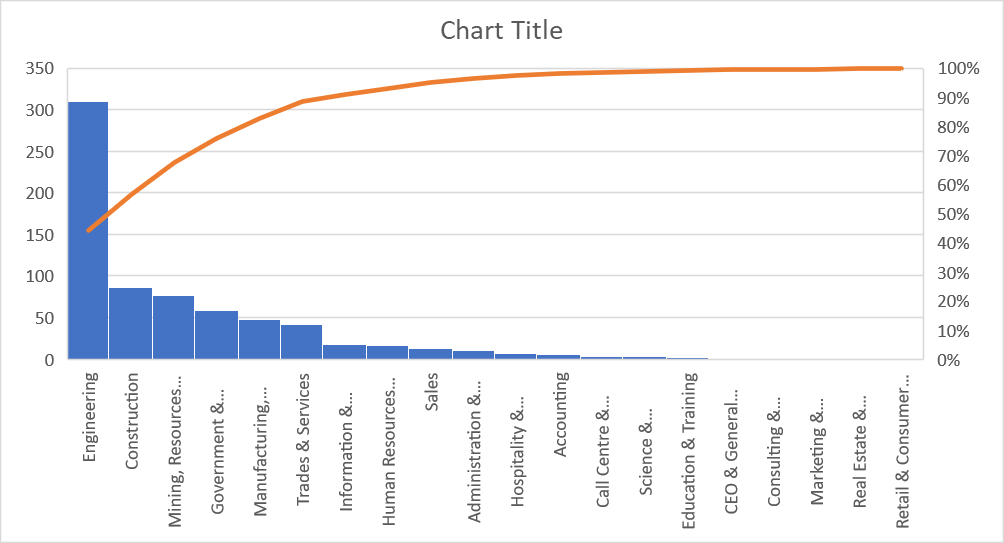
Government & Defence are big purchasers and operators of sophisticated equipment, so their need for safety expertise is high. We still make things in Australia, so Manufacturing is in there, and we also have a very strong service economy (remember I mentioned education earlier?) so Trades & Services feature as well.
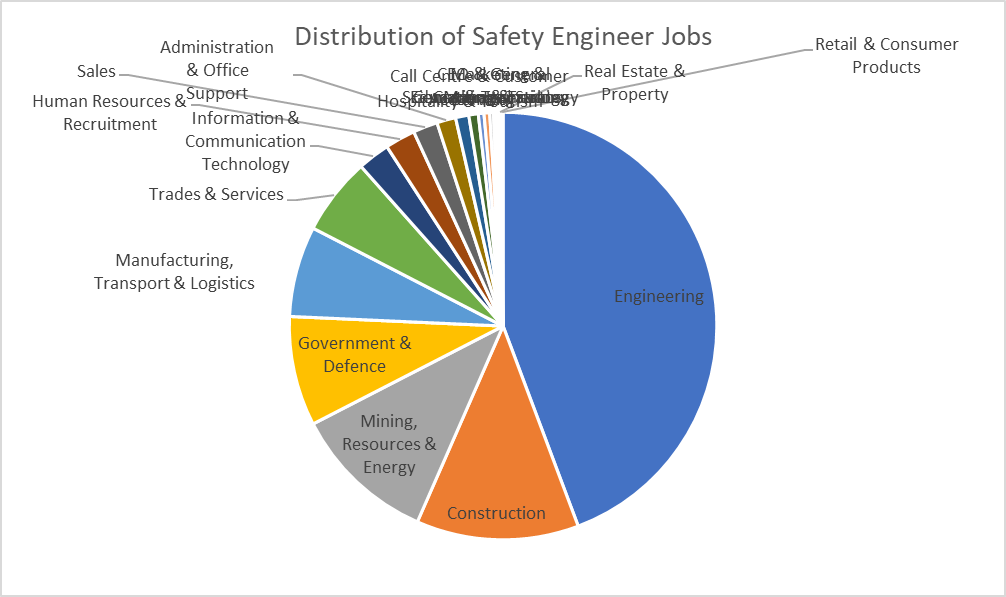
Last, ICT, Human Resources & Recruitment, Sales, etc., mop up the remaining 12%. In this ‘tail’, a wide variety of sectors advertise for just a few positions.
It’s clear that if we want to do safety engineering then we should not limit ourselves to the ‘engineering’ industry. Many more domains need and want our services.
Diving Deeper into Engineering
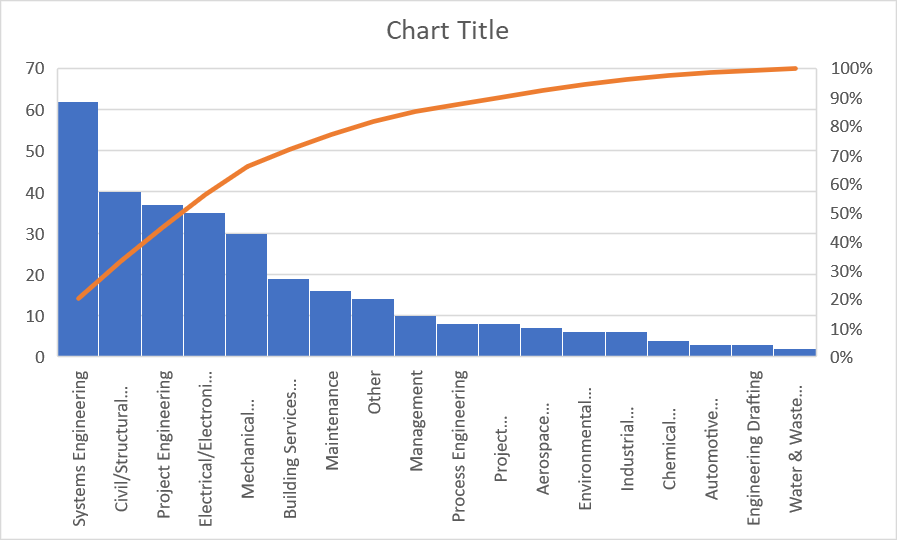
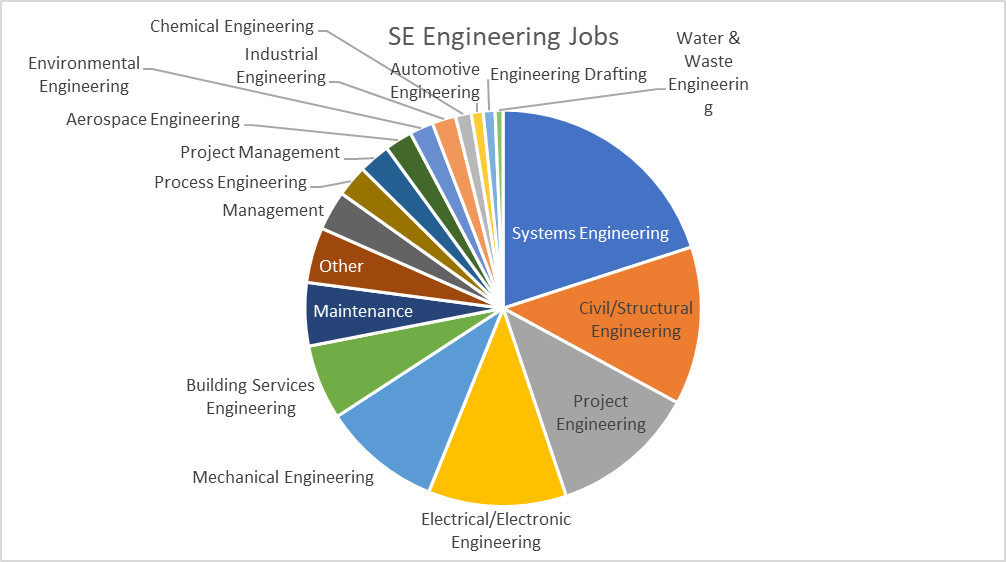
As Engineering is the biggest sector, let’s look deeper into that. Systems Engineering and Civil/Structural Engineering comprise a third of positions, as do Project Engineering, Electrical/ Electronic Engineering and Mechanical Engineering. Again, a wide variety of other sectors make up the final third.
Systems Engineering | 62 |
Civil/Structural Engineering | 40 |
Project Engineering | 37 |
Electrical/Electronic Engineering | 35 |
Mechanical Engineering | 30 |
Building Services Engineering | 19 |
Maintenance | 16 |
Other | 14 |
Management | 10 |
Process Engineering | 8 |
Project Management | 8 |
Aerospace Engineering | 7 |
Environmental Engineering | 6 |
Industrial Engineering | 6 |
Chemical Engineering | 4 |
Automotive Engineering | 3 |
Engineering Drafting | 3 |
Water & Waste Engineering | 2 |
Table – breakdown of Safety Engineer Jobs in Engineering by Sub-sector
This is illustrated nicely by the histogram, below. Note how diverse safety engineering disciplines are – no one sector really dominates here.
Again, the split is nicely illustrated by the pie chart, below. We can clearly see how the top five sectors offer two-thirds of the jobs.
System Safety Engineering Job Adverts
To see what employers say they are looking for (not everyone can write an accurate job description), I have analysed a bunch of job adverts. I looked at 22 adverts for system safety engineering jobs offering a full-time salary of up to $100k, which is basically entry-level in Australia. I concentrated on the responsibilities that applicants should expect to hold. The results are summarized in this word cloud (thanks Tag Crowd ), below.
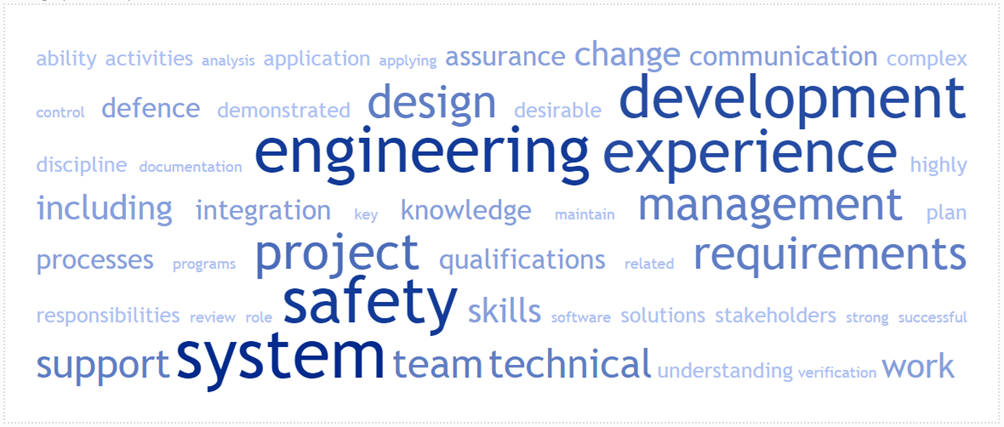
As we can see, there are some obvious words that come up repeatedly – engineering, experience, safety, system – which really tell us nothing. The next level down is more useful – development, design, management, requirements, and project. (I notice also ‘support’ and ‘team’ but these are very widely-used words, aren’t they? Nobody wants an uncooperative loner who won’t provide support.)
For context, and a better understanding, let’s look at the most common phrases in our sample (thanks Online Text Analyzer). These all recur four times in our sample:
“experience with aerospace and/or defence projects”;
“strong understanding of systems engineering principles and lifecycle”;
“with aerospace and/or defence projects highly”;
“aerospace and/or defence projects highly regarded”;
“understanding of systems engineering principles and lifecycle management”; and
“experience in complex technical development and integration projects”.
We need to be a little bit careful here. Clearly, there are one or more employers looking for experience in aerospace and defence, and their ads are using certain stock phrases repeatedly. As we’ve seen earlier in this article, ‘Government and Defence’ is a significant employer of safety engineers, but aerospace jobs are quite rare.
Nevertheless, if we look through this bias we can discern a need for understanding, particularly of systems engineering principles and the systems engineering lifecycle. We also need to deal with complex technical development and integration projects.
Thus, in summary, there is a discernible focus on:
Development & design;
Management;
Requirements;
Systems engineering principles;
Systems engineering lifecycle;
Complex technical development; and
Complex integration projects.
There is nothing here to surprise an experienced Systems Engineer (but this article isn’t really written for experts but for those who want in). It’s nice to see it spelt out: this is what employers are willing to pay for.
Next Time…
That was ‘Safety Engineering Jobs in Australia’ – back to the Blog. Need some courses to help you along? They’re here.
Next time I will look at exemplary safety engineer resumes, and I will analyse some salary bands … until then, what’s your view of the safety jobs market in Australia?